
Palladium Alloy Probe Pin Materials
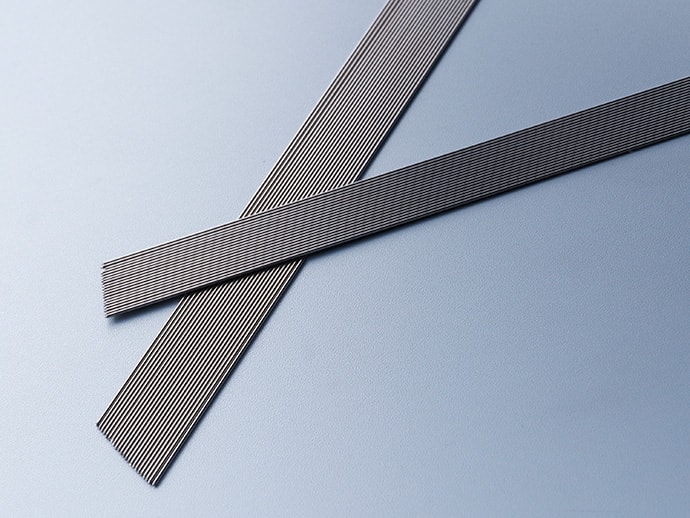
Probe pin materials are used in inspection equipment for semiconductor wafers and devices, where stable electrical contact and durability are essential.
ISHIFUKU develops and manufactures palladium alloy materials for probe pins, with a focus on high hardness, low electrical resistance, and excellent straightness. Our lineup includes materials with a hardness of 500 HV or higher, enabling reliable performance in demanding semiconductor inspection applications.
ISHIFUKU offers standard-length straight wire materials as well as pre-cut pins, and can provide products tailored to specific customer requirements.
Product Lineup
APC-H1 is a high-hardness palladium alloy material designed for advanced probe pin applications. Its composition is 45% palladium and 24.5% silver, with the balance consisting primarily of copper. Compared with standard probe pin materials, APC-H1 offers higher hardness, making it suitable for applications that require greater durability and stable electrical contact under demanding inspection conditions.
APC-H1 is especially suitable for high-end logic semiconductor inspection, where probe pins must maintain reliable performance over repeated contact cycles.
For High-End Logic Semiconductor Applications
APC-H1-
APC-αⅠ
APC-αⅠ is a palladium-silver alloy material developed for high-performance probe pin applications. With a composition of 40% palladium and 29.5% silver, with the balance consisting primarily of copper, it offers a superior balance of low electrical resistance, mechanical strength, and excellent straightness, making it suitable for precision inspection of advanced logic semiconductor devices. After aging treatment, APC-αⅠ achieves significantly higher hardness (see hardness chart below), improving durability and contact stability in demanding inspection environments.
6-element alloy is a palladium-based probe pin material composed of gold, silver, platinum, palladium, copper, and zinc. Designed for cantilever-type and wire probe applications, it provides stable electrical contact, fine wire workability, and reliable mechanical performance in semiconductor wafer and device inspection.
By combining these multiple alloying elements, 6-element alloy offers a well-balanced combination of hardness, low electrical resistance, and durability, making it especially suitable for probe designs where flexibility, contact stability, and long-term performance are required.
For Cantilever and Wire Probe Applications
6-element alloy
APC-LP25 is a palladium-silver alloy material designed for probe pin applications that require stable performance and cost efficiency. With a composition of 25% palladium and 57.5% silver, with the balance consisting primarily of copper, it offers a balanced combination of hardness and electrical resistance, making it suitable for inspection applications where material cost and reliable electrical contact are important considerations.
APC-Ⅲ
APC-Ⅲ is a palladium-silver-copper alloy material developed for semiconductor probe pin applications. It contains 35% palladium and 35% silver, with copper making up the remainder. Compared with APC-LP25, APC-Ⅲ provides a higher melting point and tensile strength. APC-Ⅲ is suitable for applications that require improved mechanical strength while maintaining a practical balance between performance and cost.
For Cost-Sensitive Products Such as Memory Semiconductors
APC-LP25Product Specifications
Composition
| Product name | Gold (%) | Silver (%) | Platinum (%) | Palladium (%) | Others (%) |
|---|---|---|---|---|---|
| APC-LP25 | - | 57.5 | - | 25 | Cu, In |
| APC-Ⅲ | - | 35 | - | 35 | Cu |
| 6-element alloy | 10 | 30 | 10 | 35 | Cu, Zn |
| APC-αⅠ | - | 29.5 | - | 40 | Cu, In |
| APC-H1 | - | 24.5 | - | 45 | Cu, In |
Physical property values
| Product name | Density (g/cm3) |
Melting point (℃) | Specific resistance (μΩ-cm) [Age-hardening material] |
Tensile strength (MPa) [Processing material] |
Hardness (HV) | |
|---|---|---|---|---|---|---|
| Processing material | Age-hardening material | |||||
| APC-LP25 | 10.5 | 995 | 12 | - | 280 | 370 |
| APC-Ⅲ | 10.5 | 1150 | 17 | 1100 | 310 | 370 |
| 6-element alloy | 11.8 | 1086 | 32 | - | 310 | 350 |
| APC-αⅠ | 10.5 | 1070 | 11.5 | 1250 | 340 | 480 |
| APC-H1 | 10.5 | 1100 | 10 | 1300 | 340 | 530 |
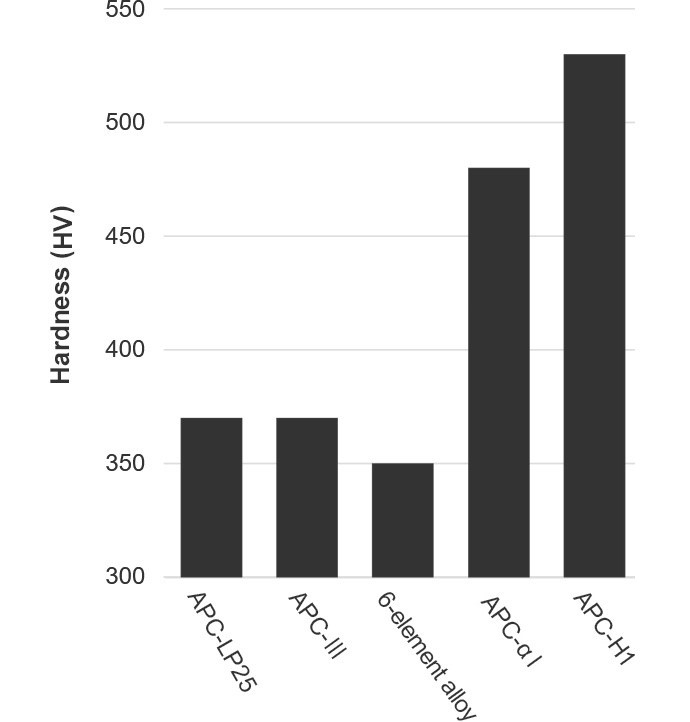
APC-H1 demonstrates the highest hardness among the compared materials, followed by APC-αⅠ. With a hardness of approximately 530 HV, APC-H1 provides excellent durability and wear resistance for demanding probe applications.
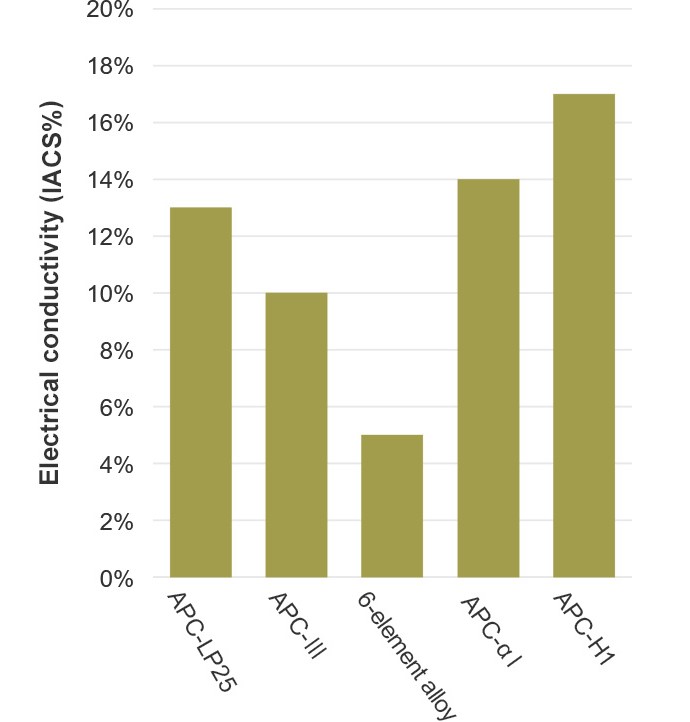
APC-H1 shows the highest electrical conductivity among the listed materials, reaching approximately 17% IACS. This indicates that APC-H1 offers excellent conductivity compared with conventional palladium alloy and other APC materials.
Heat treatment conditions and hardness of age hardening
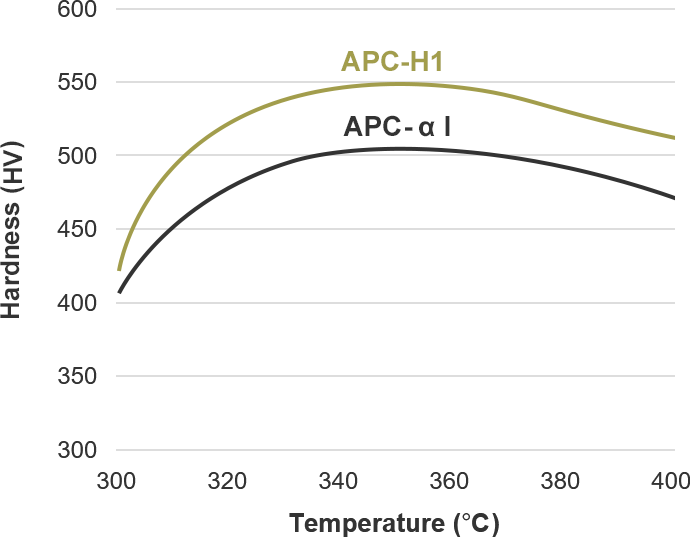
APC-H1 maintains higher hardness than APC-αⅠ across the entire temperature range.
Both materials reach peak hardness at around 350–360°C,
but APC-H1 shows superior hardness throughout, demonstrating excellent mechanical strength after heat treatment.
FAQ About Palladium Alloy
ISHIFUKU provides standard-length straight wire materials and pre-cut pins. For APC-αⅠ and APC-H1, standard specifications include wire diameters of φ0.5 mm and φ0.6 mm, a length of 2,000 mm, and straightness of 2 mm or less over 2,000 mm.
Yes. In addition to the listed standard wire diameters, ISHIFUKU may be able to manufacture other wire diameters depending on customer requirements.
Chemical components are analyzed for each production lot using ICP emission spectrometry. This lot-based inspection helps ensure that the material composition meets the specified requirements.
Inspection items include wire diameter, chemical composition, hardness, straightness, and appearance. Wire diameter is measured with a micrometer, hardness is measured using a Vickers hardness tester, straightness is checked using a reference straight edge or by comparison between wires, and appearance is inspected visually for major surface defects.
After machining, the products should be cleaned thoroughly to remove impurities and processing oil. Proper cleaning is important to help maintain material performance and avoid contamination in subsequent processes.
The materials should be stored in a cool, dry environment, away from high temperature and humidity, to prevent deterioration and ensure stable handling during subsequent processing.
Yes, both are available.
Recommended heat treatment conditions vary by product and can be provided upon request.
If you order a product without age hardening, we cannot guarantee the final hardness after self-applied age hardening.
The product contains easily oxidized elements, so heat treatment in air may cause oxidation and discoloration. If your company performs heat treatment after machining, we recommend using a non-oxidizing atmosphere.
For standard products (2,000 mm in length), the product is placed in a PVC tube, which is then packed in an inner cardboard box and finally in a larger outer cardboard box secured with PP bands.
Contact us
For inquiries, please use the form below.
We aim to fully harness the exceptional properties of precious metals.